
Blog: The Intersection of Black History Month & Birth Equity
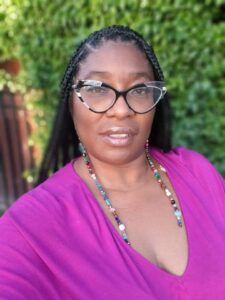 As we close out Black History Month, we are thrilled to share an exclusive interview with Adjoa Jones reflecting on the intersections of Black History with birth equity work led by communities and the Department of Public Health Maternal, Child, and Adolescent Health Programs across the county.
Adjoa is currently the Birth Equity Unit Chief and Director of the AAIMM Prevention Initiative.
Adjoa, please tell us about the birth equity work you lead at the LA County Department of Public Health.
I currently co-direct the African-American Infant and Maternal Mortality Prevention Initiative or AAIMM.
Back in 2017, I had the idea for an African-American infant and maternal mortality community action engagement model, so that community and government could come together to address the unacceptably high rate of Black infant and maternal mortality in LA County. At the time, I was pursuing an MBA and wanted to focus my research on how we could improve the efficacy of services through a partnership between communities and government, which was also informed by my work as the first community health worker and perinatal health educator for the first Black infant health program, going back to the 90s. I saw new solutions were needed. So, those initial community action teams became the impetus for the entire AAIMM initiative.
Additionally, I shepherd the Perinatal Equity Initiative, which includes fatherhood engagement, group prenatal care, and preconception and interconception counseling and education for health providers, birth workers, and community members. The Initiative also provides funding and supports for various programs and community action teams, as well as the Village Fund and other aspects of AAIMM. I also direct our first guaranteed income pilot for new mothers, called the Abundant Birth Project, which was launched last year.
Across all of these, the Department is working to improve health services for Black women, birthing persons, fathers and partners, babies, and their families to reduce death and disease and ensure they can thrive. We’re driving systemic change, including by: identifying service gaps; supporting birth workers and clinicians; spearheading policy advocacy; and collaborating closely with community-based organizations like Black Women’s Wellness and the California Black Women’s Health Project.
What are some recent successes in this work that you’re proud of?
I can honestly say that I am proud of all of our programs. However, here are four key things that come to mind.
- The staying power of our four community action teams: Some of these teams started back in 2018/2019, and two were birthed during the pandemic. They’re still growing, and even as challenges arise, no one has given up because the community believes they’re important. We have diverse participation as well, from students to grandmothers, dads, pastors, grassroots organizations, birth workers, and much more, who all want to see progress, but are also looking for education and grounding in community.
- The early success of the ‘Abundant Birth’ guaranteed income project: In the first year, we enrolled 410 women who were most at-risk for critical pregnancy and birthing outcomes, and 200 of them have already completed the program. Continued interest from engaged mothers shows that the program is worth expanding, and we’re excited to transition from a pilot to a long-term initiative. They want to share the benefits with others across the city. Within our first cohort, we had one mother who was homeless but will now be completing her degree at LACC and giving a commencement speech in June. Another mother also became a Village Fund grantee.
- A new model for engaging fathers: To address challenges with engaging fathers consistently, we partnered with the Black Infant Health Program (BIH) for a pilot around fatherhood ambassadors who would lead community outreach with men in the community. Since the start of the pilot, we’ve seen enormous growth in engagement. In April, during National Public Health Week, we’ll be focusing on several fatherhood engagement efforts countywide. Because of this success, other divisions and programs have reached out for guidance on how they can replicate this model.
- The Motherboard as an exemplar of community engagement: None of the success we’ve had could have been done without community partners and the partnership between community and government. Programs like the Motherboard, where mothers and community members are working to craft policy and county services and programs for what they know is needed during pregnancy and childbirth, and changing the narrative around the possibility for joyous and celebratory birthing in the Black community.
This month is Black History Month. How do you view birth equity as being part of the lineage of Black History and Black futures?
We don’t have any history without our foremothers who set the tone for birthing in this nation. They were granny midwives, wet nurses, mothers, who evolved from the days of slavery when some of these roles weren’t always a choice; in the years following, many adapted and embraced these community roles, further developing life-saving skills and experience while incorporating historical practices.
We also have so many Black women who sacrificed their lives to give us the foundation of modern birth equity. Like Anarcha, Lucy, and Betsy, who were forcibly experimented on by J. Marion Sims, and Henrietta Lacks. There are others in more modern times, like April Valentine, Dr. Shalon Irving, and Mrs. Bridgette Cromer, someone who people don’t even know because she was a mother of five living in the LA projects who died as a result of a potentially preventable maternal death just two weeks before taking the NCLEX-PN exam for practical and vocational nurses to advance her career.
The work we do is deeply connected to this history and our ancestors’ experiences. There is no “us” without support during pregnancy and childbirth. We’ve come through hard and trying times, and now we are working to be in a better place where birthing for Black folks isn’t harmful, and we have bodily autonomy and decision-making power.
Black birth equity is required for this nation, not just for Black futures, but the future of America. It is the foundation, the first thing we must fund and support, and we won’t give up.
What are some ways funders and institutions in LA can help promote Black maternal health this year?
They can show up for the work that’s being done, see the history of where we came from, and recognize what we have accomplished in LA County with our birth equity programs in the last eight years alone.
I would ask them to then think about what we’d be able to accomplish with sustainable funding – with 5, 10, 20 years of financing earmarked. To rewrite the harm that’s been done for 450 years, we need more than one to two years to advance birth equity.
There are so many ways to support and so many aspects of this work to get excited about – whether it’s fatherhood engagement, backbone support for community outreach, midwifery, breast and chest feeding, making birth joyous, reopening maternity wards to prevent maternity deserts, or reducing preeclampsia – there’s an entry point for every type of funder.
So that’s my one ask: partner with us and invest sustainably.