Blog: Rest Before You’re Forced to Rest: A Conversation with Sonya Young Aadam on Sabbaticals, Shared Leadership, and Sustaining the Movement
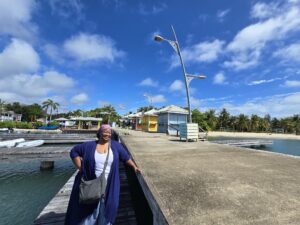
Sonya Young Aadam is the Chief Executive Officer of the California Black Women’s Health Project (CABWHP), a statewide organization committed to health and social justice for Black women and girls. After more than a decade of leadership – and two rejected sabbatical applications – Sonya recently took a long-overdue sabbatical funded by the efforts of her own team. We sat down with her to talk about what it took to get there, what she learned, and why rest isn’t a luxury for those pursuing social change.
Why do you believe that intentional rest is central to sustaining a healthy and effective racial and social justice movement?
Racial and social justice movements will wear you out and take you down. These are fights that have gone on since [Black] people were brought to this country, and they continue to this day. The potential for rest, for some form of tag-teaming – now you’ve got the baton, now you’ve got the baton – is essential. And for Black women in particular, the challenge is that we will hold the baton longer. We will pick up another person’s baton, because that’s part of what we do, what we’ve been taught to do, what we honestly, in some way, feel comfortable doing. Nevertheless, with all of that, it takes its toll.
“Rest before you’re forced to rest” is a motto of mine, and I don’t follow it all the time. But ten years into my leadership at CABWHP, I knew it was past time to be intentional about finding some rest. I was thirsting for it. I paced the floor trying to figure out how it could even be possible.
When did you know it was time to step away – and what advice would you give to others assessing their own readiness?
There’s the time for the organization, and then there’s the time for the leader. For an organization, the signal is when you’re moving so fast – even if things are going well – that you can’t slow down enough to reimagine how you’re doing the work. The community and the landscape are changing. Are you setting aside time to change with them?
For a leader personally, you either choose an intentional time for pause, or it will be chosen for you. It’s really asking yourself: do you want to wait until something forces you to stop? Or do you want to be more thoughtful about your own life and say, “I’d better do this sooner?”
My advice is don’t wait until you desperately need it to begin thinking about taking a pause. Some organizations build rest into their culture; for example, every seven years, a leader gets a sabbatical. We never had that, and we’re now contemplating it. Ask yourself: what would a good time look like to pause? And begin planning well before you arrive there.
You actually applied for a sabbatical twice through foundation programs and were denied both times. Can you share what happened?
The first time I applied, I poured everything into it. The application required me to articulate the how, the why, what I would do, and what I imagined I would feel having done it. I dreamed about it. I visualized it. And when I didn’t get it, it was crushing.
The reason? The foundation told me that my team and organization were not ready for me to be away. And as painful as that was, it was also a massive wake-up call. I needed the rest, but the more important realization was that I was managing an organization where I had 150% ownership of nearly every operational and administrative task. The kitchen, as I like to call these tasks, was a hot mess that only I could manage. The table of service we set for the community was beautiful, but the kitchen was only something I could manage. And that meant working late nights, every weekend, every vacation. My sixteen-year-old once told me we had never been on a trip where I didn’t spend most of the time working and finding activities to keep the family busy so I could keep working. He was right.
So over the next two years, we did the hard work – brought in consultants, examined our leadership model, built shared systems. We sought out advisors, including Bridgespan, and I had a three-hour breakfast with Charisse Bremond at Brotherhood Crusade that felt like a master class in trust and leadership. By the time I reapplied, the org was ready. But that cycle of the program had shifted its funding priorities, and I didn’t get it again.
So how did the sabbatical finally happen?
My team made it happen. Five of them got together and decided: We’re going to raise the money ourselves and design our own sabbatical. They researched foundation models, reached out to our funders, collected on some outstanding debts the org was owed — and raised enough to match what one of the foundation sabbatical packages would have looked like.
I mean, it’s like a Hallmark movie. It really is.
Once the funding was there, we handled all the logistics: signatures, banking authority, payroll systems, everything. We brought in a coach to work between me and the team while I was out. The agreement was clear: no contact. My phone didn’t work for them anymore. There was one running joke – if Mackenzie Scott called to offer one of those $5 million grants, then they were allowed to reach me.
I went back to that very first sabbatical application I had written years earlier, because those things were still my dreams. I took saxophone lessons – something I had wanted to do since I was thirty. My husband had bought me a saxophone nine years earlier, and I had never once opened the case. I visited my best friend in Miami with no agenda, no events, no itinerary. I just showed up. I slept without an alarm for the first time in what felt like…ever. In the first week, days would turn into nights, and I was still napping.
The sabbatical was three and a half months, with another month to phase back in. And when I came home, we were able to give financial incentives to the staff members who had really stepped up. And for my birthday, the team had the saxophone teacher come in and serenade me with all the Stevie Wonder songs I love. It was a total surprise that still warms my heart.
Shared leadership and trust are two conditions that make intentional rest possible. How can organizations cultivate them?
Let me be honest – building a shared leadership model is challenging, and often idealistic for small nonprofits that are waiting on the next grant. We are a statewide organization with a staff of fifteen. Fifteen. And that’s twice as many as we had seven years ago.
When you’re a CEO of a small nonprofit, you don’t have all the departments. You end up being HR, finance, strategy, and operations all at once. And the people you hire for programmatic expertise don’t necessarily come with all of the administrative or financial skills. Building those skills takes time and investment, and pulling people away from programming to develop them is its own challenge.
We could not have done it without outside support – Bridgespan, Center for Liberated Leadership, consultants, advisors. But there are also organizational cultural practices that matter. I ask every potential employee: Would you ever consider running an organization? Could you see yourself in the CEO role if you were trained for it? I listen carefully to that answer. Because if the answer is no, that tells me something. I’m the fifth CEO of a 32-year-old organization. I have a responsibility to think about who comes next and to build the conditions that make a strong transition possible.
One of the most important things I’ve learned: don’t be the one with all the secrets. Something happened to me in 2017 – a serious head injury that kept me from driving for six months. The team had to hold it together with only five people. That was a wake-up call about what it means for an organization to be leader-dependent. You want people who understand the systems, the compliance requirements, the operations – not because they’re your backup, but because that’s what a healthy organization looks like.
Why should funders, who are often results-driven, consider supporting a sabbatical – “an absence of work?”
The problem is in the framing. If funders think of it as an absence of work, that’s where they’ll go wrong. A sabbatical is an investment in the sustained capacity of an organization. It’s preventative. It’s upstream.
Think of it this way: if a funder has invested in an organization and the leader burns out, gets sick, or dies – and the organization falls apart – that funder has lost their investment. I saw five Black women die in what I call the “line of duty” during my first few years as a CEO, all running nonprofits in the greater Los Angeles area. Five. In a few years. That is what can happen when we don’t invest in the wellness and sustainability of our leaders.
Foundations talk about trust-based philanthropy. They talk about narrative change, power building, supporting the development of movements. If that’s real, then they have to recognize that movements take time, are a heavy lift, and can be dangerously stressful. You have to give people who are doing that work a chance to step back, breathe, strengthen themselves, and get back in.
Results-driven funders should also look at the data: burnout in the nonprofit sector is not abstract. It has real consequences for programs, communities, and the organizations funders have put years of investment into. Supporting rest is supporting outcomes.
Did anything about the sabbatical surprise you?
Several things. One of the personal surprises – and I’d been warned about this – was what happened when I suddenly had so much time with my family. They’re not on sabbatical. They’ve known a certain version of me for years, and now here I am, slowing down, taking naps, just… being. My family would look at me like: Is she okay? What is this? Even extended family couldn’t quite compute this calmer, unhurried version of me.
The other surprise was how quickly I forgot the details of work. About three weeks in, I couldn’t remember access codes, process details, system names – things I had thought about every single day. My brain just… released them. It knew I didn’t need them right then. I was shocked. I hadn’t realized how much mental space the work was occupying every waking moment.
And then there was the glass on the edge of the table. That’s how I describe my leadership style. If I see something about to fall, I don’t watch it hit the floor. I just fix it. Because once it breaks, the cleanup is more work. My coach, Kelechi Umbozoh, asked me as I was preparing to return: When you go back and see things on the edge of the table, what’s your plan? How do you not become that person again?
I learned to watch things fall. At home, I practiced. There were messes I intentionally let happen and chose not to clean up. I never would have done that before. It taught me something real about boundaries – something I’ve taught in Sister Circles for years but never fully practiced myself. And I came back to the work with that capacity for boundaries genuinely developed, not just modeled.
For organizations where a formal sabbatical isn’t feasible, what other ways can they make space for rest, renewal, and expansiveness?
Rest doesn’t have to be expensive. The park is free. The beach is free. We discovered Stoneview Nature Center years ago as a place where we could hold a meeting in the morning and then give people time to walk the gardens, sit in nature, breathe. We build that kind of intentional exhale into our organizational culture.
There are other things, too. We have an extended bereavement policy because three days is not enough time to grieve. Grief doesn’t follow a calendar. Six months later, someone might need a day because they finally have space to feel what they couldn’t feel in the immediate aftermath. We build for that.
When staff are going through something hard, I look for ways to show care with whatever resources we have – a spa gift certificate for someone who loves that, a day off, a change of scenery. Wellness is programming. The sabbatical is programming. We call it that, because that’s what it is.
The bigger aspiration is to build rest into the culture by design – into the employee handbook, into the grant budget as a line item. Not waiting for a funder to give us permission. Saying: we need rest. We’re naming it. We’re funding it ourselves. That’s the model I want to see more organizations move toward.
In the tradition of Black feminist thought, rest has been framed as resistance. How can the nonprofit and philanthropic sector embrace rest as a racial and gender justice issue?
The conversation is growing. The language is evolving to elevate rest as a cultural and political practice. And for Black women specifically, this is about being empowered to choose rest, not just get it when we can. That’s a profound difference.
I’m 60 years old. I never saw my grandmothers or my mother choose rest. It was not modeled for me. But through this movement – through the work happening in maternal health, reproductive justice, community care – we are building something different. Something that says: never go alone. Never go to a doctor’s appointment alone. Bring your people with you. Stop to take care of you.
We live in a moment where, if we thought we were making progress, we’re being reminded otherwise. The policies coming down right now are coming for us – for Black women, for our organizations, for our communities. And knowing that, the need for rest becomes even more urgent. We have to share the baton. We have to go under sometimes. We have to find somewhere to hide and breathe, because the fight is not over and it is not getting easier.
What I want to see is Black women-led organizations coming together to talk about what we’re building individually and to design something collective. Can we put rest as a line item in a grant budget? Can we write it into an employee handbook? Can we create a fiscal sponsorship model that supports organizations building this into their infrastructure?
We can. And I know we can because we did it. We raised the money ourselves, designed the program ourselves, and wrote it down. Any organization can do this now. We will show you how.
Sonya Young Aadam is the Chief Executive Officer of the California Black Women’s Health Project. This conversation has been edited and condensed for clarity.